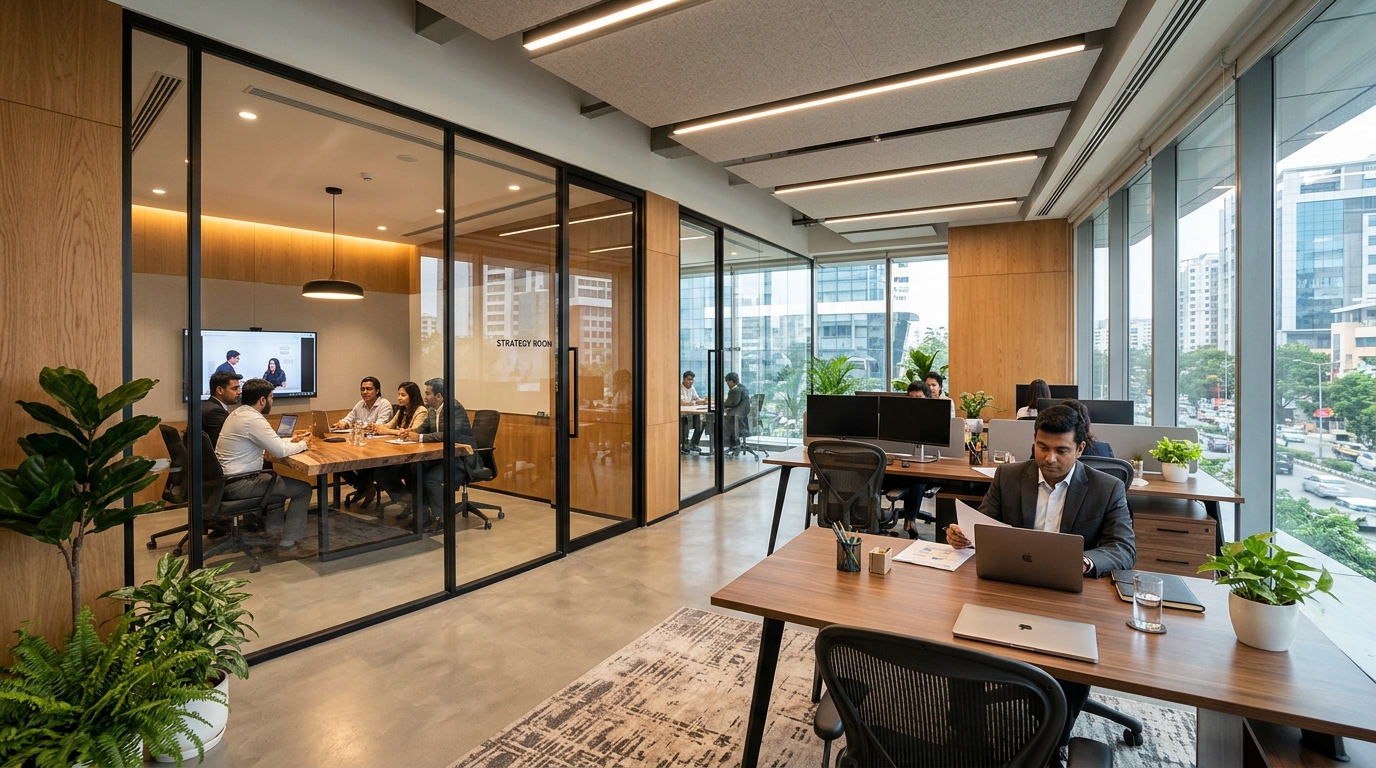
The Share Foods Coordination Disaster
Share Foods, a fast-scaling delivery venture, placed 20 team members in an Indiranagar coworking hub at ₹8,000 per seat. On paper, it was ideal. In reality, the provider could not allocate contiguous seating. Tech was split across two wings, sales sat on another floor, and operations occupied isolated hot desks.
What should have been quick whiteboard syncs morphed into Slack ping-pong, coordination lag, and fractured focus. Impromptu problem solving vanished. Six months later, they transitioned to a 25-seat managed office. Velocity rebounded immediately.
The Dedicated Desk Paradox
Coworking pricing models conceal an economic crossover:
- Hot Desks: ₹5,000 – ₹8,000 / seat (floating, unreserved, zero storage).
- Dedicated Desks: ₹8,000 – ₹12,000 / seat (fixed desk in shared floor).
- Private Managed Office: ₹8,000 – ₹14,000 / seat (fully private suite, dedicated branding, private conference rooms).
Once you purchase dedicated desks, your expenditure mirrors managed office leasing — yet you still endure crowded meeting room queues, background noise, and communal distractions.
"We thought coworking was flexible and cost-effective. It was neither. We paid ₹1.6 lakhs per month for a setup that made our team less effective. The breakeven isn't just about desk rent; it's about team velocity."
The Breakeven Math for a 20-Person Team
Consider a 20-member team in Koramangala or HSR Layout:
- Coworking Dedicated Desks: 20 seats × ₹10,000 = ₹2,00,000 / month.
- Bespoke Managed Office: 20 seats × ₹12,000 = ₹2,40,000 / month.
- Net Monthly Variance: ₹40,000 (₹4.8 lakhs annually).
For an additional ₹40,000 per month, the company unlocks complete privacy, custom security badge access, a private boardroom, sound-insulated cabins, and an environment that projects stability to prospective hires and enterprise clients.
The Hidden Drag of Communal Coworking
Shared spaces impose productivity taxes that never appear on landlord invoices:
- Meeting Room Contention: Waiting hours for an available booth to conduct an investor or client call.
- Acoustic Bleed: Competing pitch calls and open-floor commotion eroding cognitive focus.
- Recruiting Friction: Senior candidates frequently perceive unbranded coworking hot desks as impermanent, hindering executive recruitment.


The Decision Matrix: When to Switch
Use this operational framework to determine your workspace strategy:
- Under 10 Seats / Asynchronous Teams: Coworking is optimal. Preserve capital and prioritize zero lock-in flexibility while discovering product-market fit.
- 10 to 15 Seats (Inflection Zone): Review team interdependence. If daily collaboration is critical, begin evaluating 12-month managed suites with expansion options.
- Above 15 Seats: Managed office is structurally superior. The productivity gains, cultural cohesion, and dedicated facilities outweigh minor cost differences.
Flexibility is only valuable if it serves execution. When workspace fragmentation hampers team velocity, staying in coworking becomes an expensive compromise.
Evaluating Coworking vs Managed Space for Your Growing Team?
We analyze your hiring velocity, meeting room usage, and net seat economics to find the optimal office setup.
Compare Office Options